 sharply
contested. The wars of his age were wars for the control of cities, and
Jehan has spent a great deal of his life both inside and outside their
walls in the struggle.
sharply
contested. The wars of his age were wars for the control of cities, and
Jehan has spent a great deal of his life both inside and outside their
walls in the struggle.
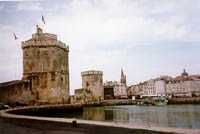
La Rochelle is in the Aunis region, which is not exactly Périgord, but is key to the French Southwest. Its prominence as a stronghold made it the de facto capital of the Protestant community in France for almost two centuries. It became a refuge in the aftermath of the St. Bartholomew's Day massacre (1572), and was besieged for refusing to admit the royal governor in '73. Jehan has spent many long, cold, rainy hours on the parapets looking out toward the sea, with its inscrutable vastness. Lucky for him, he didn't live to see Cardinal Richilieu's dike across the harbor starve the town into submission in 1628. An amazing feat of engineering, it took 18 months to reduce the city. Of a population of 30,000 people, less than 5,000 lived to surrender. It was a crucial step in the path to absolute monarchy in France.
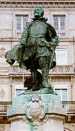 The statue
in the Place outside the Hôtel de Ville is of Jean Guiton, the heroic
mayor of La Rochelle in 1628. It was donated by the citizens of New Rochelle
in the United States, which was founded by Huguenot refugees fleeing the
town after the revocation of the Edict of Nantes in 1685.
The statue
in the Place outside the Hôtel de Ville is of Jean Guiton, the heroic
mayor of La Rochelle in 1628. It was donated by the citizens of New Rochelle
in the United States, which was founded by Huguenot refugees fleeing the
town after the revocation of the Edict of Nantes in 1685.
 St.
Emilion
St.
Emilion
 Coutras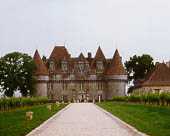
 Nobles with the
rights of high justice on their domains could hold religious services on
their own estates even when they were banned in public. The Seigneurs de
Monbazillac protected refugee Protestant pastors, and the chateau was used
for religious meetings and consistories. The Périgord was heavily
Protestant, a fact reflected in the Salle de Protestantisme in the chateau
today, where various artifacts such as maps, engravings, letters, medals,
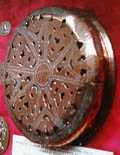
and personal mementos of the Protestant movement are preserved. The design
on the copper warming pan shows the "Huguenot cross" and a dove, popular
Protestant symbols.
Nobles with the
rights of high justice on their domains could hold religious services on
their own estates even when they were banned in public. The Seigneurs de
Monbazillac protected refugee Protestant pastors, and the chateau was used
for religious meetings and consistories. The Périgord was heavily
Protestant, a fact reflected in the Salle de Protestantisme in the chateau
today, where various artifacts such as maps, engravings, letters, medals,
and personal mementos of the Protestant movement are preserved. The design
on the copper warming pan shows the "Huguenot cross" and a dove, popular
Protestant symbols.
And if you should ever choose to sojourn in the area, the nearby guest house of La Rouquette, set amongst the vineyards of Monbazillac, is absolutely delightful, reasonably priced, and possessed of a very gracious hostess. (24240 Monbazillac Dordogne, France, tel. #05 53 58 30 60).
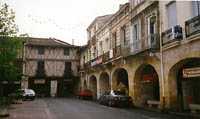
A bastide is a fortified town built on a characteristic grid pattern -- they were built all over this region from the 13th to 15th centuries to provide protection to the ordinary people in the wars between England and France. Bastides typically have a central square with an covered market and a fortified church. The houses surrounding the square have colonnades on the ground floor, with shops inside. The shop owners, families, and apprentices lived on the floors above.
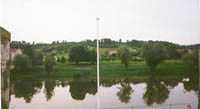 The quay below
the ramparts along the river is a peaceful spot in the evening. The air
is alive with swallows, the water makes it slow and inexorable way to the
sea, and the gently rolling hillsides stretch away like the curves of a
well-beloved woman.
The quay below
the ramparts along the river is a peaceful spot in the evening. The air
is alive with swallows, the water makes it slow and inexorable way to the
sea, and the gently rolling hillsides stretch away like the curves of a
well-beloved woman.
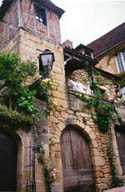 Sarlat-la-Caneda
Sarlat was the home of La Boëtie, Montaigne's dearest friend. La
Boëtie died fairly young, and Montaigne mourned for him the rest of
his life.
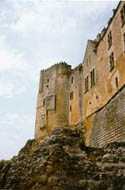 Beynac
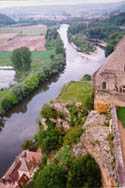 Beynac
certainly has a strategic location. Perched on a cliff in a cingle
of the Dordogne (a loop in the river), it commands the countryside
around. It was a possession of Richard Coeur-de-Lion, and his routier
captain Mercadier who held it for him is still remembered with hostility
by the locals. It was rebuilt in 1236 by the barons of Beynac, but has
been added onto over the centuries. Just across the river is its heriditary
enemy, Castelnaud. During the Hundred Years War the Dordogne River was
the frontier between France and England, and through a good part of that
time Beynac stood on the French side and Castelnaud on the English side.
During the Wars of Religion, both Beynac and Castelnaud were held by the
Protestants, and sealed off the valley from the Catholics. Beynac was the
meeting place of the estates of Périgord, and the banners of the
four great baronies of the province still hang in the great hall.
Beynac
certainly has a strategic location. Perched on a cliff in a cingle
of the Dordogne (a loop in the river), it commands the countryside
around. It was a possession of Richard Coeur-de-Lion, and his routier
captain Mercadier who held it for him is still remembered with hostility
by the locals. It was rebuilt in 1236 by the barons of Beynac, but has
been added onto over the centuries. Just across the river is its heriditary
enemy, Castelnaud. During the Hundred Years War the Dordogne River was
the frontier between France and England, and through a good part of that
time Beynac stood on the French side and Castelnaud on the English side.
During the Wars of Religion, both Beynac and Castelnaud were held by the
Protestants, and sealed off the valley from the Catholics. Beynac was the
meeting place of the estates of Périgord, and the banners of the
four great baronies of the province still hang in the great hall.
 The chateaux
and bastides of Perigord have a great many natural advantages, even if
the fortifications are a little old-fashioned to Jehan's eyes (he spent
enough time throwing up makeshift "fortifications
à la Huguenotte" around medieval town walls in his day).
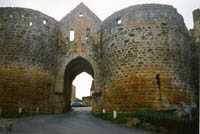
The well-preserved bastide town of Domme
was built in the 13th century and had a reputation for being impregnable
(although like everywhere else in the region, it changed hands several
times during the Hundred Years War). Besides its thick walls and gates,
it is built at the top of a cliff, and one side of the ramparts has a sheer
drop down to the river. It was captured for the Protestants in 1588 by
Henri de Navarre's captain, Geoffrey de Vivans. The Protestants made a
noisy demonstration outside the main gates and while the defenders were
distracted, 30 men scaled the cliff in the dark, climbed over the wall,
overpowered the watch, and opened the gates from the inside. Vivans finally
sold the town back to the Catholics in 1592, but he blew up the church
(since restored) before leaving.
The chateaux
and bastides of Perigord have a great many natural advantages, even if
the fortifications are a little old-fashioned to Jehan's eyes (he spent
enough time throwing up makeshift "fortifications
à la Huguenotte" around medieval town walls in his day).
The well-preserved bastide town of Domme
was built in the 13th century and had a reputation for being impregnable
(although like everywhere else in the region, it changed hands several
times during the Hundred Years War). Besides its thick walls and gates,
it is built at the top of a cliff, and one side of the ramparts has a sheer
drop down to the river. It was captured for the Protestants in 1588 by
Henri de Navarre's captain, Geoffrey de Vivans. The Protestants made a
noisy demonstration outside the main gates and while the defenders were
distracted, 30 men scaled the cliff in the dark, climbed over the wall,
overpowered the watch, and opened the gates from the inside. Vivans finally
sold the town back to the Catholics in 1592, but he blew up the church
(since restored) before leaving.
Underneath the market is an entrance to the Grottes de Domme -- stunningly beautiful caverns full of fantastic stalagmites and stalactites. Apparently the populace took refuge here during times of trouble.
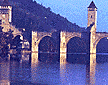 Cahors is not in
the Périgord, but in Quercy, a little to the South. It was primarily
a Catholic town in the 16th century.
Cahors is not in
the Périgord, but in Quercy, a little to the South. It was primarily
a Catholic town in the 16th century. 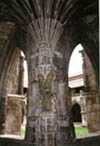 It
was captured briefly by Henri de Navarre in 1580, in a spectacular campaign
involving fierce house-to-house fighting. He stayed one night in a house
that still bears his name. It is a lovely town that has existed since Roman
times in a bend of the Lot River, surrounded on three sides by the water.
It is famous for its "black wine."
It was home to a medieval university, a pope (John XXII), and the hero
of the Third Republic, Leon Gambetta. The
Pont Valentré, part of the town's early fortifications, is still
one of its notable features. The cloisters around the Eglise St. Etienne
are still beautiful, although they show the ravages of the religious wars
and the Revolution, when many of their statues and decorations were defaced.
It
was captured briefly by Henri de Navarre in 1580, in a spectacular campaign
involving fierce house-to-house fighting. He stayed one night in a house
that still bears his name. It is a lovely town that has existed since Roman
times in a bend of the Lot River, surrounded on three sides by the water.
It is famous for its "black wine."
It was home to a medieval university, a pope (John XXII), and the hero
of the Third Republic, Leon Gambetta. The
Pont Valentré, part of the town's early fortifications, is still
one of its notable features. The cloisters around the Eglise St. Etienne
are still beautiful, although they show the ravages of the religious wars
and the Revolution, when many of their statues and decorations were defaced.
 Home
to Poulet Gauche
Home
to Poulet Gauche  Bibliography